Exam pattern
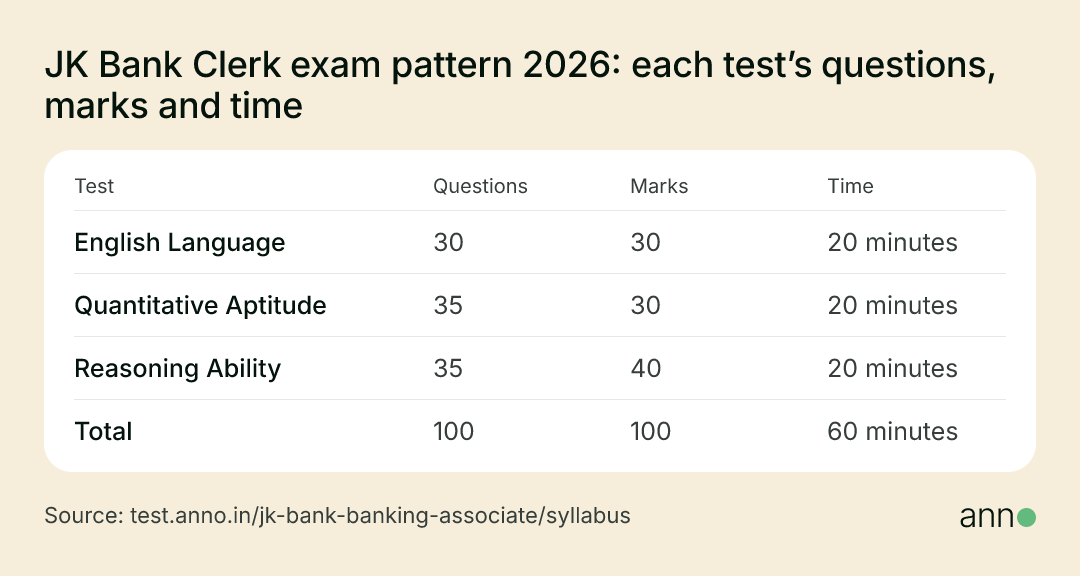
100 questions for 100 marks in 60 minutes: English Language (30 questions, 30 marks, 20 minutes), Quantitative Aptitude (35 questions, 30 marks, 20 minutes), Reasoning Ability (35 questions, 40 marks, 20 minutes).
| Test | Questions | Marks | Time |
|---|---|---|---|
| English Language | 30 | 30 | 20 minutes |
| Quantitative Aptitude | 35 | 30 | 20 minutes |
| Reasoning Ability | 35 | 40 | 20 minutes |
| Total | 100 | 100 | 60 minutes |
- IBPS conducts it, online. Each test is timed on its own, and all are in English.
- A wrong answer costs one fourth of that question’s marks. A blank costs nothing.
- You must reach a cut-off in each test and on the total. The least aggregate that can qualify is 40% (35% in a reserved category); merit decides after that.
- The marks are not divided as they were last time. In May 2022 the tests carried 30, 35 and 35 marks; this year’s carry 30, 30 and 40.
Download the syllabus PDFThe selection process and the cut-off rules
Sources
J&K Bank: Detailed Notification for Recruitment of Banking Associates, UT of J&K (2026); J&K Bank: Recruitment of Banking Associates, the cut-offs of the test of 14, 15, 17 and 18 May 2022, signed by IBPS on 19 August 2022. The notification, No. JKB/HR/Rectt/2026-493 of 7 Nov 2026, pages 9 and 10.
Syllabus topics, test by test
J&K Bank’s notification names the tests and gives no topics. These are the topics IBPS’s papers of this pattern ask, most marks first, counted from 115 past papers of IBPS’s clerk and PO prelims (2016 to 2026).
English Language
30 marks · 30 questions · 9 topics.
Reading Comprehension, Error Detection, Sentence Rearrangement, Word Swap, Word Rearrangement and Misspelt or Misused Words, Cloze Test, Sentence Improvement and Phrase Replacement, Fill in the Blanks, Vocabulary and Sentence Formation from Columns.
Each English topic’s marksNumerical Ability
30 marks · 35 questions · 16 topics. The notification calls this test Quantitative Aptitude.
Data Interpretation, Simplification and Approximation, Number Series, Quadratic Equations, Time, Speed and Distance, Trains, and Boats and Streams, Ratio and Proportion, and Partnership, Averages and Ages, Percentage, Time and Work, and Pipes and Cisterns, Simple and Compound Interest, Profit, Loss and Discount, Mixtures and Alligation, Mensuration, Quantity Comparison and Data Sufficiency, Permutation, Combination and Probability and Number System.
Each Numerical topic’s marksReasoning Ability
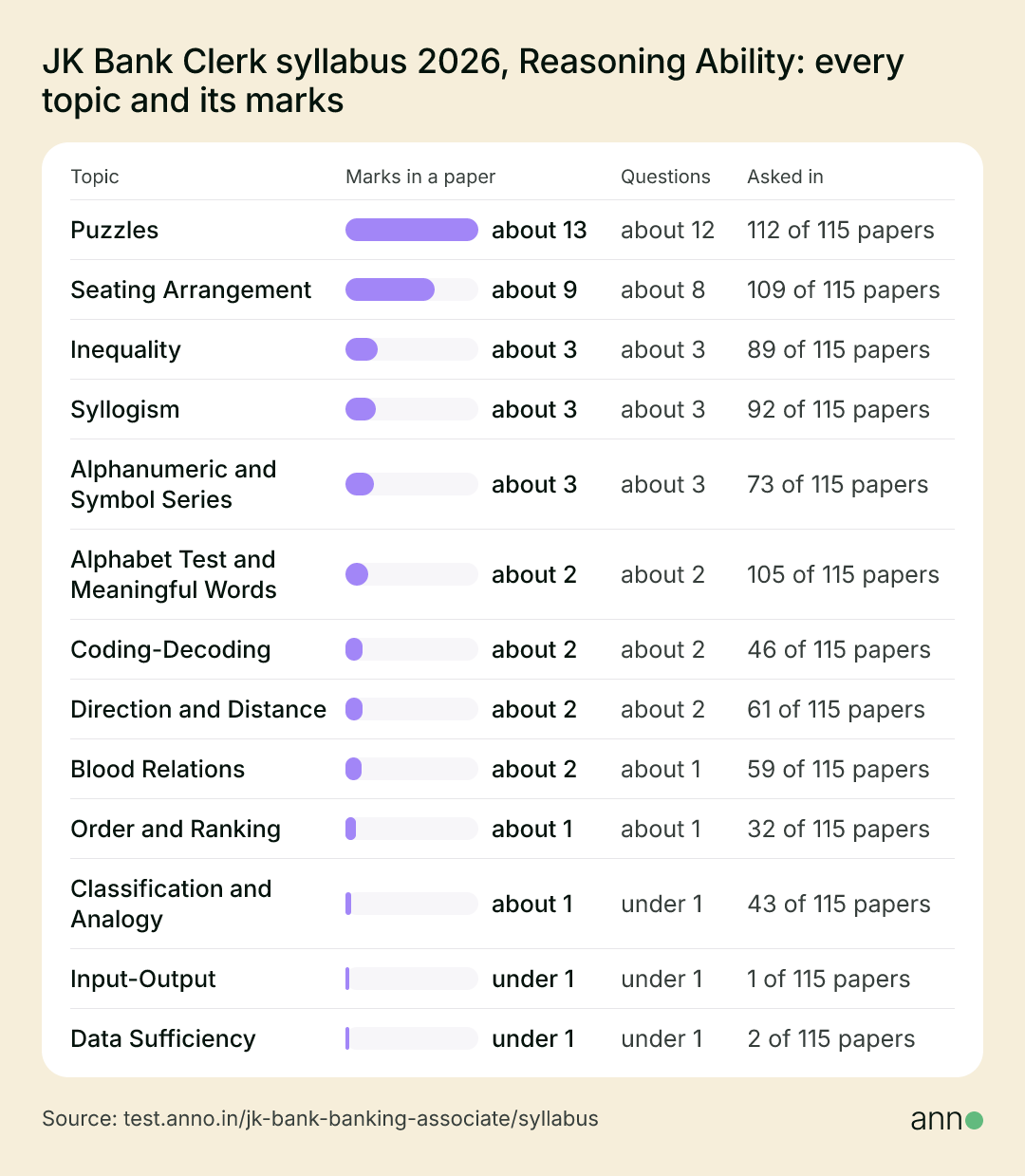
40 marks · 35 questions · 13 topics.
Puzzles, Seating Arrangement, Inequality, Syllogism, Alphanumeric and Symbol Series, Alphabet Test and Meaningful Words, Coding-Decoding, Direction and Distance, Blood Relations, Order and Ranking, Classification and Analogy, Input-Output and Data Sufficiency.
Each Reasoning topic’s marks
Most important topics: where the marks are
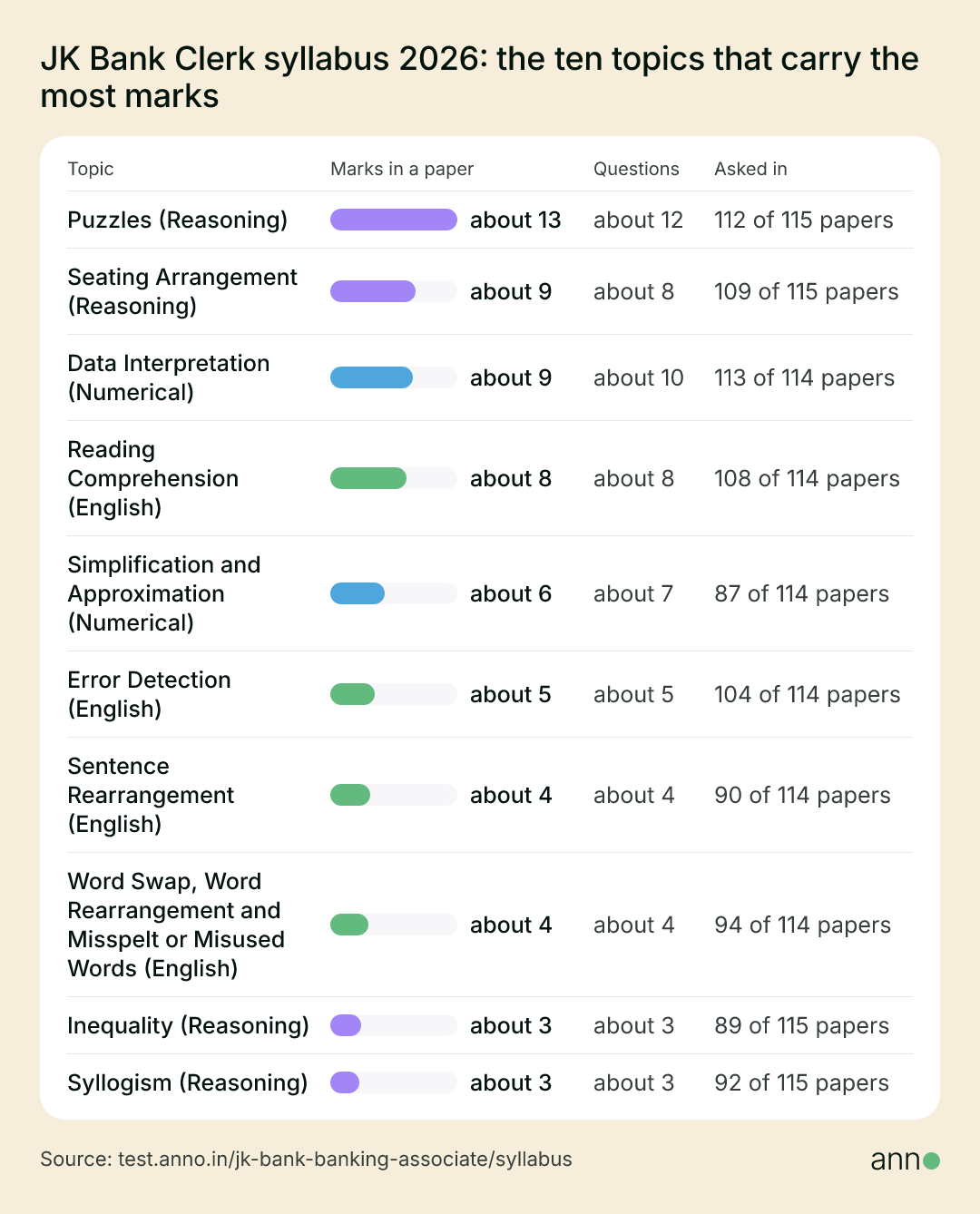
The ten topics that carry the most marks in an average paper. The first five carry about 44 of 100 marks.
| Topic | Marks in a paper | Questions | Asked in |
|---|---|---|---|
| PuzzlesReasoningFloor, box, month and day based, scheduling and comparison puzzles | about 12 | 112 of 115 papers | |
| Seating ArrangementReasoningLinear, parallel rows, circular, square and rectangular | about 8 | 109 of 115 papers | |
| Data InterpretationNumericalTables, bar graphs, line graphs, pie charts, caselets and Venn diagrams | about 10 | 113 of 114 papers | |
| Reading ComprehensionEnglishPassages with questions on their facts, inferences, tone and the meaning of words | about 8 | 108 of 114 papers | |
| Simplification and ApproximationNumerical | about 7 | 87 of 114 papers | |
| Error DetectionEnglishFinding the part of a sentence that has an error | about 5 | 104 of 114 papers | |
| Sentence RearrangementEnglishPara jumbles | about 4 | 90 of 114 papers | |
| Word Swap, Word Rearrangement and Misspelt or Misused WordsEnglish | about 4 | 94 of 114 papers | |
| InequalityReasoningDirect and coded | about 3 | 89 of 115 papers | |
| SyllogismReasoning | about 3 | 92 of 115 papers |
English Language: every topic’s marks
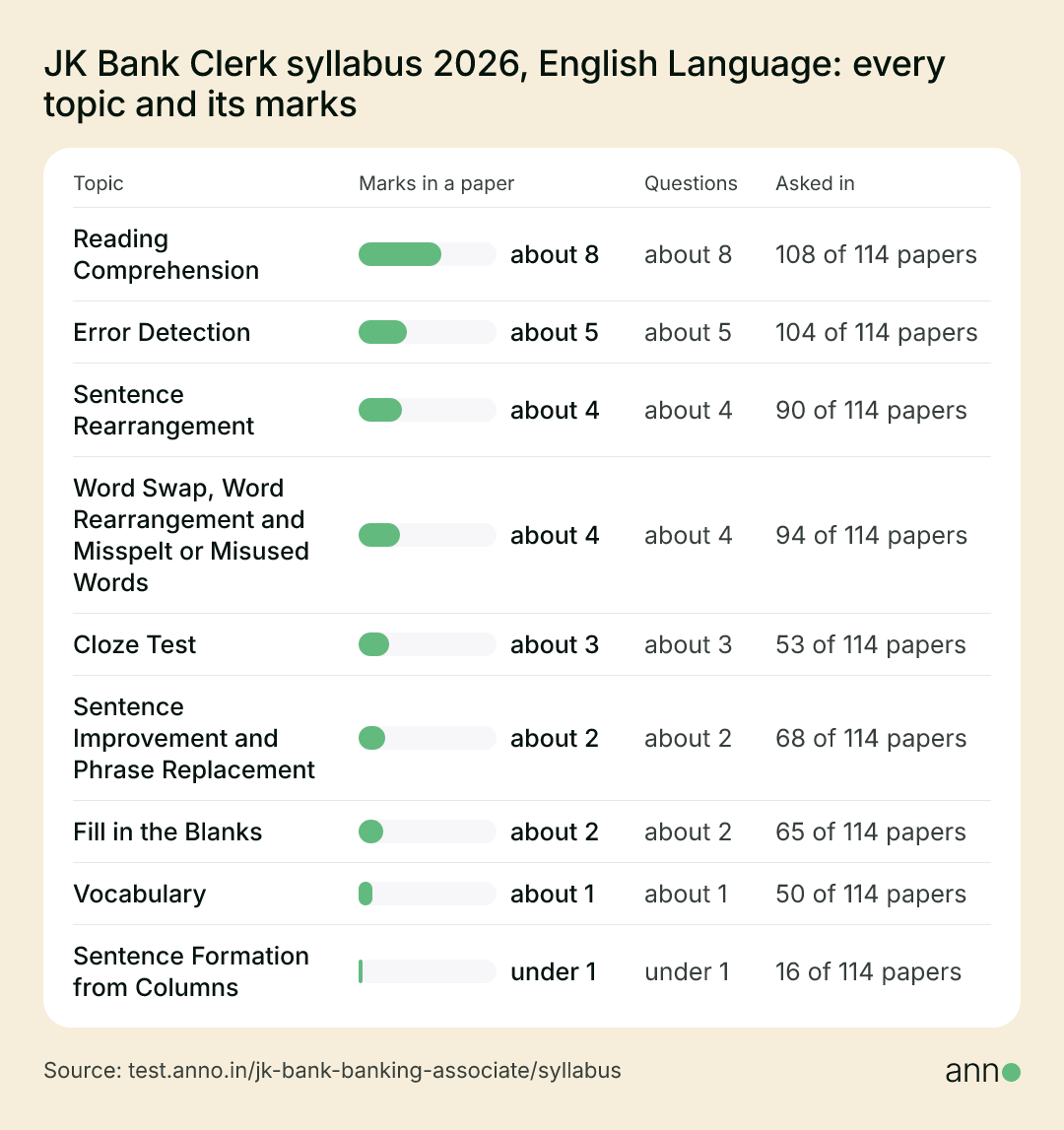
30 marks · 30 questions · 9 topics. How to plan English
| Topic | Marks in a paper | Questions | Asked in |
|---|---|---|---|
| Reading ComprehensionPassages with questions on their facts, inferences, tone and the meaning of words | about 8 | 108 of 114 papers | |
| Error DetectionFinding the part of a sentence that has an error | about 5 | 104 of 114 papers | |
| Sentence RearrangementPara jumbles | about 4 | 90 of 114 papers | |
| Word Swap, Word Rearrangement and Misspelt or Misused Words | about 4 | 94 of 114 papers | |
| Cloze Test | about 3 | 53 of 114 papers | |
| Sentence Improvement and Phrase Replacement | about 2 | 68 of 114 papers | |
| Fill in the BlanksSingle and double fillers | about 2 | 65 of 114 papers | |
| VocabularySynonyms, antonyms and the use of words | about 1 | 50 of 114 papers | |
| Sentence Formation from ColumnsMatch the column | under 1 | 16 of 114 papers |
Numerical Ability: every topic’s marks
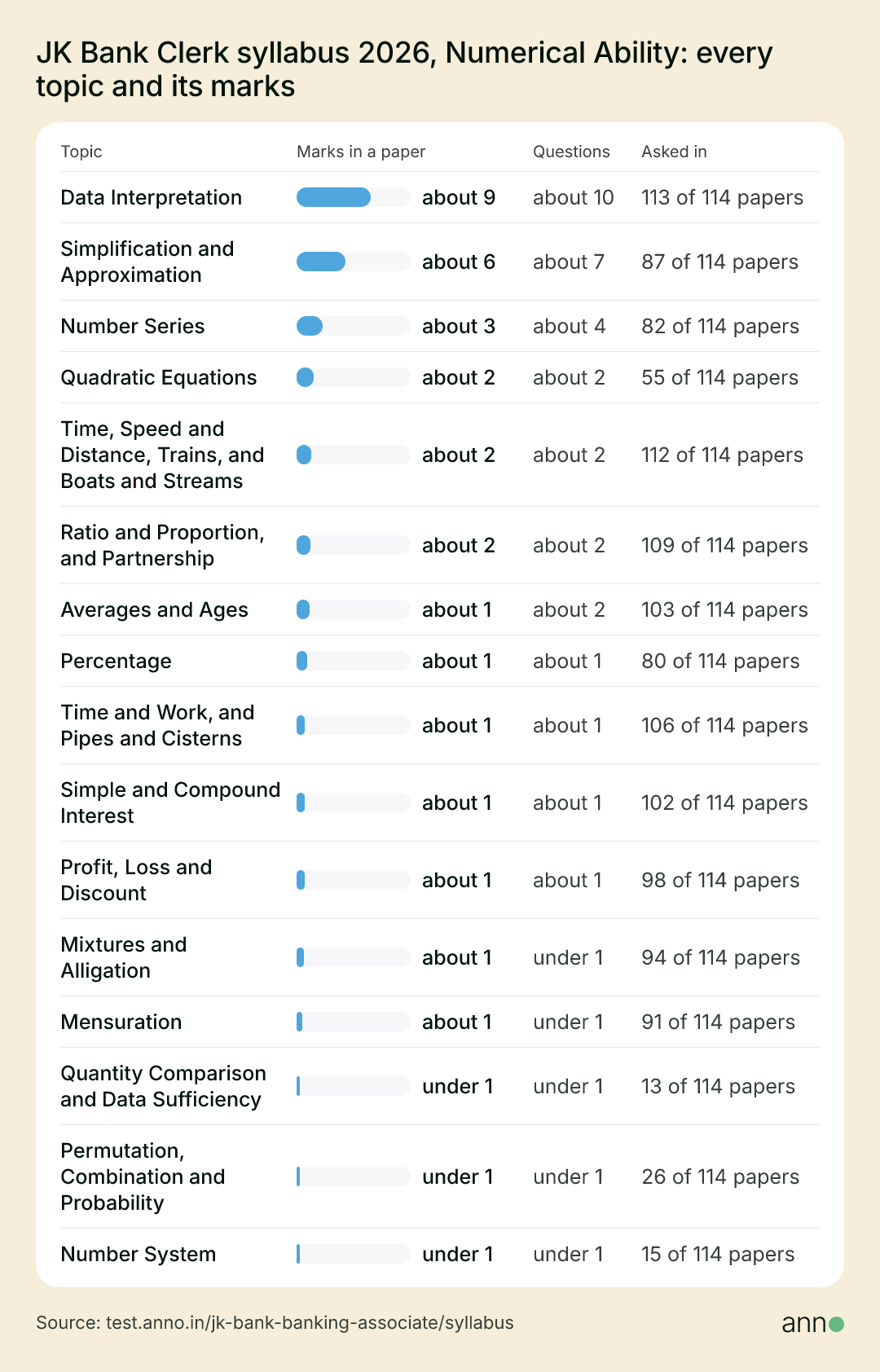
30 marks · 35 questions · 16 topics. How to plan Numerical
| Topic | Marks in a paper | Questions | Asked in |
|---|---|---|---|
| Data InterpretationTables, bar graphs, line graphs, pie charts, caselets and Venn diagrams | about 10 | 113 of 114 papers | |
| Simplification and Approximation | about 7 | 87 of 114 papers | |
| Number SeriesMissing number and wrong number | about 4 | 82 of 114 papers | |
| Quadratic EquationsComparing the roots of two equations | about 2 | 55 of 114 papers | |
| Time, Speed and Distance, Trains, and Boats and Streams | about 2 | 112 of 114 papers | |
| Ratio and Proportion, and Partnership | about 2 | 109 of 114 papers | |
| Averages and Ages | about 2 | 103 of 114 papers | |
| Percentage | about 1 | 80 of 114 papers | |
| Time and Work, and Pipes and Cisterns | about 1 | 106 of 114 papers | |
| Simple and Compound Interest | about 1 | 102 of 114 papers | |
| Profit, Loss and Discount | about 1 | 98 of 114 papers | |
| Mixtures and Alligation | under 1 | 94 of 114 papers | |
| MensurationAreas and volumes | under 1 | 91 of 114 papers | |
| Quantity Comparison and Data Sufficiency | under 1 | 13 of 114 papers | |
| Permutation, Combination and Probability | under 1 | 26 of 114 papers | |
| Number SystemProperties of numbers, divisibility, HCF and LCM | under 1 | 15 of 114 papers |
Reasoning Ability: every topic’s marks
40 marks · 35 questions · 13 topics. How to plan Reasoning
| Topic | Marks in a paper | Questions | Asked in |
|---|---|---|---|
| PuzzlesFloor, box, month and day based, scheduling and comparison puzzles | about 12 | 112 of 115 papers | |
| Seating ArrangementLinear, parallel rows, circular, square and rectangular | about 8 | 109 of 115 papers | |
| InequalityDirect and coded | about 3 | 89 of 115 papers | |
| Syllogism | about 3 | 92 of 115 papers | |
| Alphanumeric and Symbol Series | about 3 | 73 of 115 papers | |
| Alphabet Test and Meaningful Words | about 2 | 105 of 115 papers | |
| Coding-Decoding | about 2 | 46 of 115 papers | |
| Direction and Distance | about 2 | 61 of 115 papers | |
| Blood Relations | about 1 | 59 of 115 papers | |
| Order and Ranking | about 1 | 32 of 115 papers | |
| Classification and AnalogyOdd one out | under 1 | 43 of 115 papers | |
| Input-Output | under 1 | 1 of 115 papers | |
| Data Sufficiency | under 1 | 2 of 115 papers |
FAQ
What is the JK Bank Clerk syllabus 2026?
Three tests: English Language (30 marks), Quantitative Aptitude (30 marks) and Reasoning Ability (40 marks). J&K Bank’s notification names the tests and gives no topics. The topics on this page are the ones IBPS’s papers of this pattern ask; Puzzles, Seating Arrangement, Data Interpretation, Reading Comprehension and Simplification and Approximation carry the most marks.
What is the JK Bank Clerk exam pattern 2026?
100 questions for 100 marks in 60 minutes: English Language (30 questions, 30 marks, 20 minutes), Quantitative Aptitude (35 questions, 30 marks, 20 minutes), Reasoning Ability (35 questions, 40 marks, 20 minutes). Each test is timed on its own.
Is there a JK Bank Clerk syllabus PDF?
Yes: this syllabus with each topic’s marks, as a PDF, free to keep and pass on. J&K Bank itself publishes no topic-wise syllabus.
Which are the most important topics for JK Bank Clerk?
Puzzles (about 13 marks), Seating Arrangement (about 9 marks), Data Interpretation (about 9 marks), Reading Comprehension (about 8 marks), Simplification and Approximation (about 6 marks), counted from 115 past papers. Together they carry about 44 of 100 marks.
Is General Awareness or Computer Knowledge in the JK Bank Clerk exam?
Not in this year’s notification. It names three tests, English Language, Quantitative Aptitude and Reasoning Ability, and no other.
Is there negative marking in the JK Bank Clerk exam?
Yes. A wrong answer costs one fourth of that question’s marks. A question left blank costs nothing.
Is the JK Bank Clerk exam like IBPS’s own clerk exam?
IBPS conducts it on the same pattern as IBPS’s own clerk exam. J&K Bank gives no topic list of its own, so Anno counted the topics from 115 past papers of IBPS’s clerk and PO prelims (2016 to 2026).
Has the JK Bank Clerk exam pattern changed?
The marks have. In J&K Bank’s last Banking Associate exam (May 2022) the three tests carried 30, 35 and 35 marks; this year’s notification sets 30, 30 and 40. Check any table you use against the notification.
In which language is the JK Bank Clerk exam?
English. Every test is in English.
Is the JK Bank PO syllabus the same?
Its preliminary exam has the same three tests, with the same questions and marks, so these topics serve for it too. Its mains exam is its own. The JK Bank PO syllabus.
Is there a free mock test on this syllabus?
Yes. Anno’s quick mock test is 30 questions in 20 minutes with no sign-up, and there are 5 full mock tests on the exam’s pattern. The JK Bank Clerk mock test.
Are there JK Bank Clerk previous year question papers?
Not official ones: J&K Bank does not publish its papers. What exists, and what the papers ask.
More about the exam
Eligibility
Aged 20 to 30 on 1 Jan 2026, a graduate, a domicile of the UT of J&K. More years for reserved categories.
Who can applySelection process
One online exam by IBPS: 100 questions in 60 minutes. How the cut-off and the merit list work.
The exam and the cut-off rulesSalary
Starting basic pay ₹24,050: about ₹43,500 a month with allowances. Benefits, and the way up to officer.
Pay in hand, benefits and promotion
Dates, pattern and cutoffMock testPrevious year papersThe estimate and the last official cut-offExam date, admit card and result